Command wizards
Two wizards write a console command or a task from a form, instead of typing the boilerplate: the Symfony command wizard
(src/Command/) and the Castor task wizard (castor.php or .castor/). Both also read an existing command or task back into
the form to edit it, and both can run what they describe from a form of their own.
Symfony command
Open it from Tools > New Symfony Command…, from the + of the Symfony console window, or, to change a command that exists, with Edit in the wizard on it in that window.
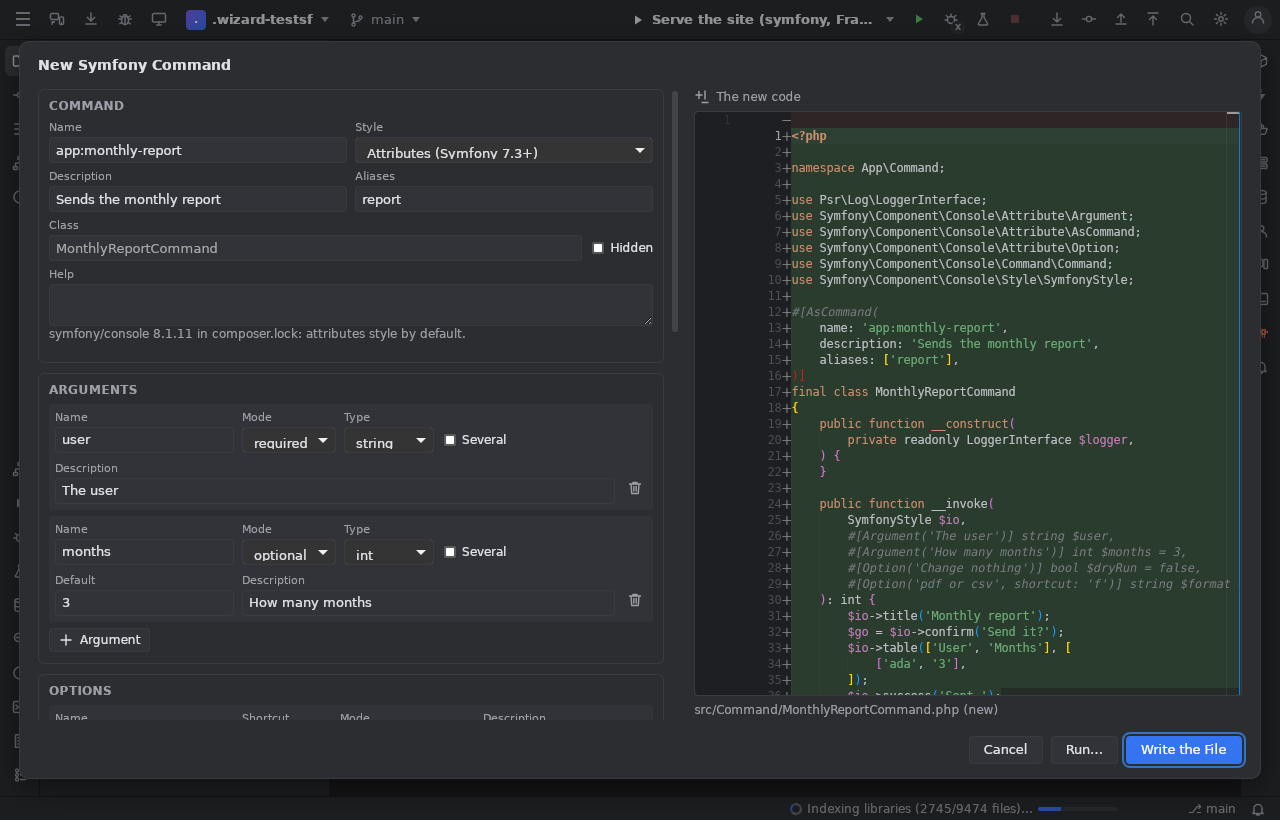
The form is on the left, the new code on the right, updated as you type.
- Command: name (
app:monthly-report), class, description, aliases, Hidden, help text, and the style: Attributes (Symfony 7.3+:#[AsCommand]on a class with__invoke(), parameters marked#[Argument]/#[Option]) or Classic (configure()withaddArgument()/addOption(), andexecute()). The default follows the version ofsymfony/consoleincomposer.lock; the form says which one it found. - Arguments: name, mode (required / optional), type, Several (an array), default value, description.
- Options: name, shortcut, mode (flag, value required, value optional, several values,
--x / --no-x), type, default, description. - Services: classes or interfaces found by the PHP index, injected in the constructor as
private readonly. - Body: click the steps of the palette to add them in order: SymfonyStyle title, section, text, ask, confirm, choice, progress bar,
table, success / note / warning / error messages, free lines of PHP. Then choose what the command returns
(
Command::SUCCESS,FAILUREorINVALID).
The file is written to src/Command/<Class>.php, in the namespace that the psr-4 section of composer.json gives.
Castor task
Open it from Tools > New Castor Task…, from the menu of the Scripts window, or with Edit in the Wizard… on a Castor task.
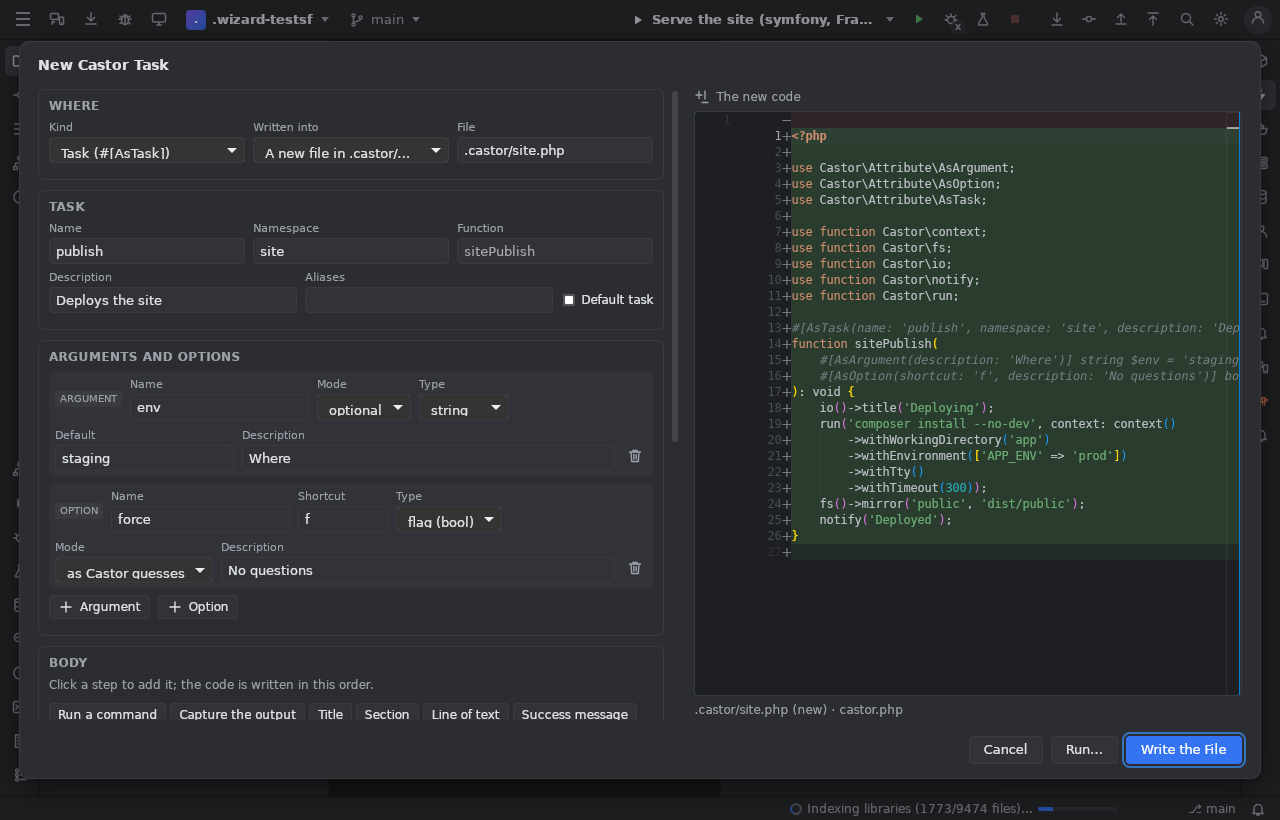
- Where: the kind and where it is written:
castor.php(created when missing) or a file of.castor/(the root file then gets itsimport(__DIR__ . '/.castor/x.php')). Theuselines are added in alphabetical order. - Task (
#[AsTask]): name, namespace, description, aliases, Default task. A function name that PHP already has (reset,copy…) is avoided:db:resetbecomesdbReset(). - Arguments and options (
#[AsArgument]/#[AsOption]): mode, shortcut, type, default, description. The attribute is left out when Castor guesses the same thing. - Context (
#[AsContext]): working folder, environment, data, TTY, timeout, allow failure, quiet. Listener (#[AsListener]): a function called on a Castor event. - Body steps:
run()andcapture()with a context (working directory, environment, TTY, timeout, allow failure),io()output and questions,fs()operations,http_request(),watch(),notify(),variable(), lines of PHP.
Writing, editing and running
- Every change is shown as a diff first, with the files it touches (a new
.castor/file and the root file that imports it), and written only when you click Write the File. If a file changed since the preview, nothing is written: open the wizard again. - Editing an existing command or task reads it back into the form (both Symfony styles, and the older
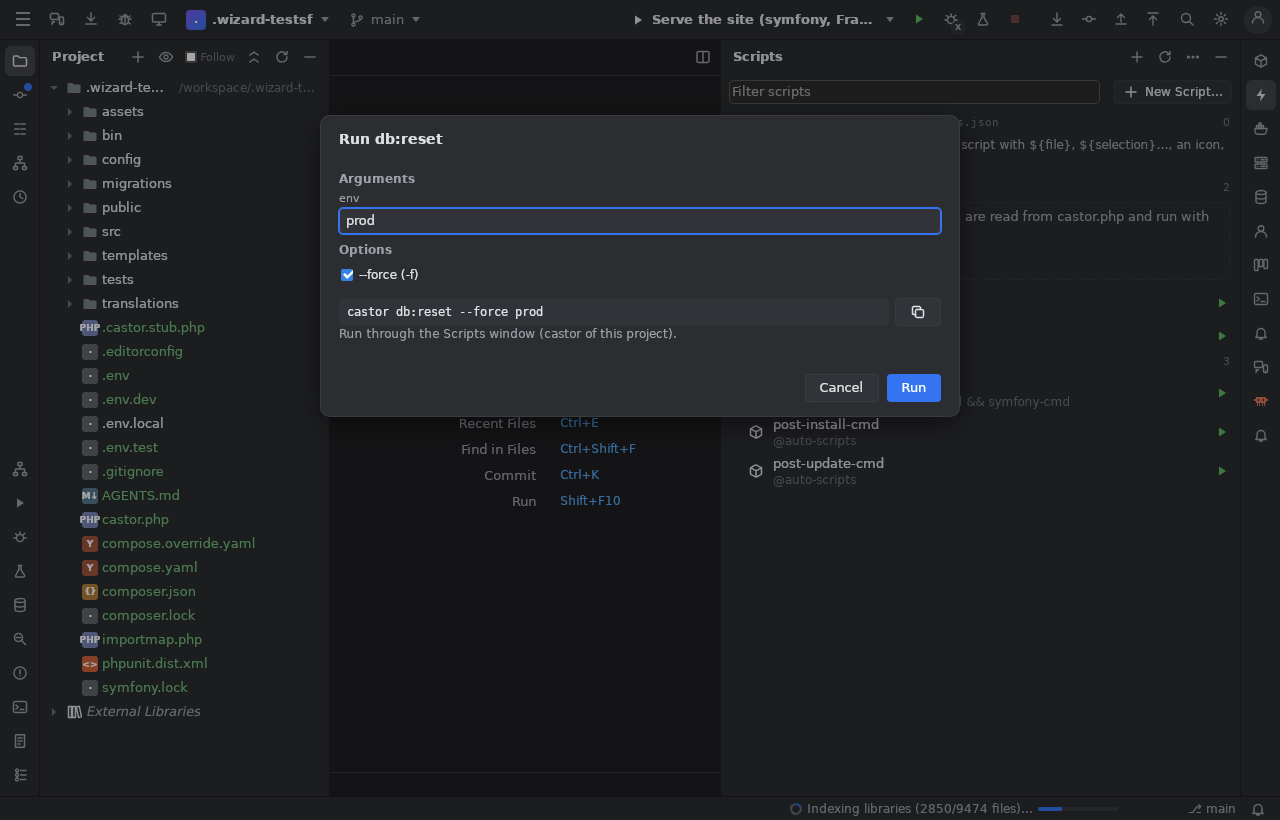
setDescription()/'name|alias'forms). Only what you changed is rewritten: new arguments, options and services are inserted in the list's own layout, removed ones go away, and every other byte of the file stays as it was. A renamed argument's variable follows in the body. The body is never touched by an edit. - Run… opens the run form: a field per argument, a checkbox or field per option, and the command line it makes (with a copy button). A Symfony command runs through the Console window's runner (a Terminal tab, or Run here when it asks nothing); a Castor task runs through the Scripts window. Run with Arguments… on a Castor task opens the same form.
Limits
- The body of an existing command or task is not read back into steps: the wizard keeps it as it is.
- Services are added by an edit; to remove one, edit the class in the editor.
- A Castor context or listener is created by the wizard, not edited by it.
help:inside#[AsCommand]needs Symfony 7.3; the classic style usessetHelp().