HTTP client
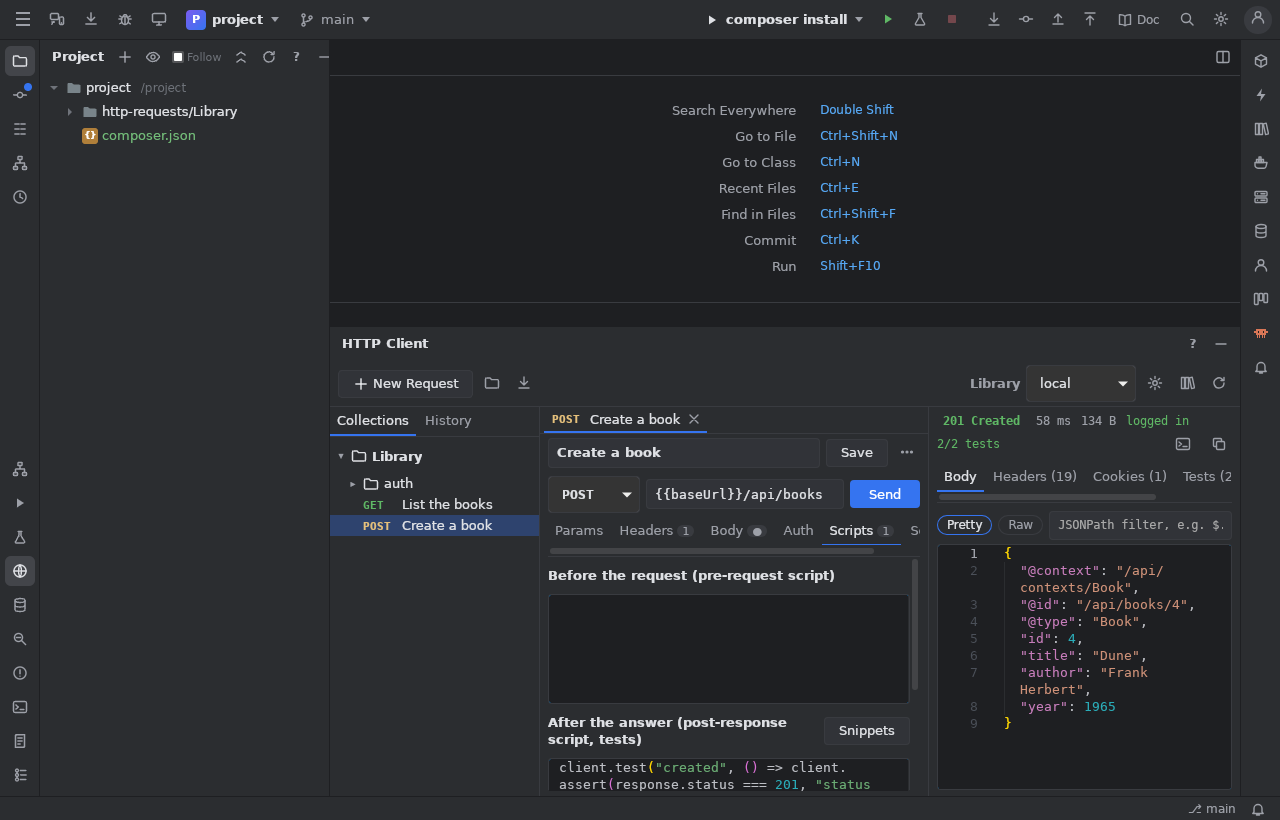
The HTTP Client window (bottom tool bar, globe icon) writes and sends the requests of your API: collections, environments, authentication, scripts and tests, history. The OpenAPI window (right) shows the API description of the project and opens any operation in the HTTP Client.
Collections and files
Everything is plain text in the project, committed and reviewed like code:
http-requests/<collection>/collection.json        name, auth, headers, sharing
http-requests/<collection>/http-client.env.json   the environments
http-requests/<collection>/<folder>/<request>.http
New Request makes a request in the collection; the folder button opens a collection. Ctrl+Enter sends, Ctrl+S saves. The History tab keeps what was sent.
A request file is the .http format that other editors read (request line, headers, blank line, body), with the IDE's own settings
in # @ comments that those editors skip:
# @name Create a book
# @seq 2
# @auth jwt login=auth/login.http path=$.token var=token
# @no-redirect
# @insecure
# @timeout 30
POST {{baseUrl}}/api/books
Content-Type: application/ld+json

{"title": "Dune"}

> {%
  client.test("created", () => client.assert(response.status === 201));
  client.global.set("bookId", response.body.id);
%}
# @name and # @seq (order), # @no-redirect, # @insecure (accept a self-signed certificate) and # @timeout are per request.
A script between < {% … %} runs before the request, one after > {% … %} runs after the answer.
Environments and variables
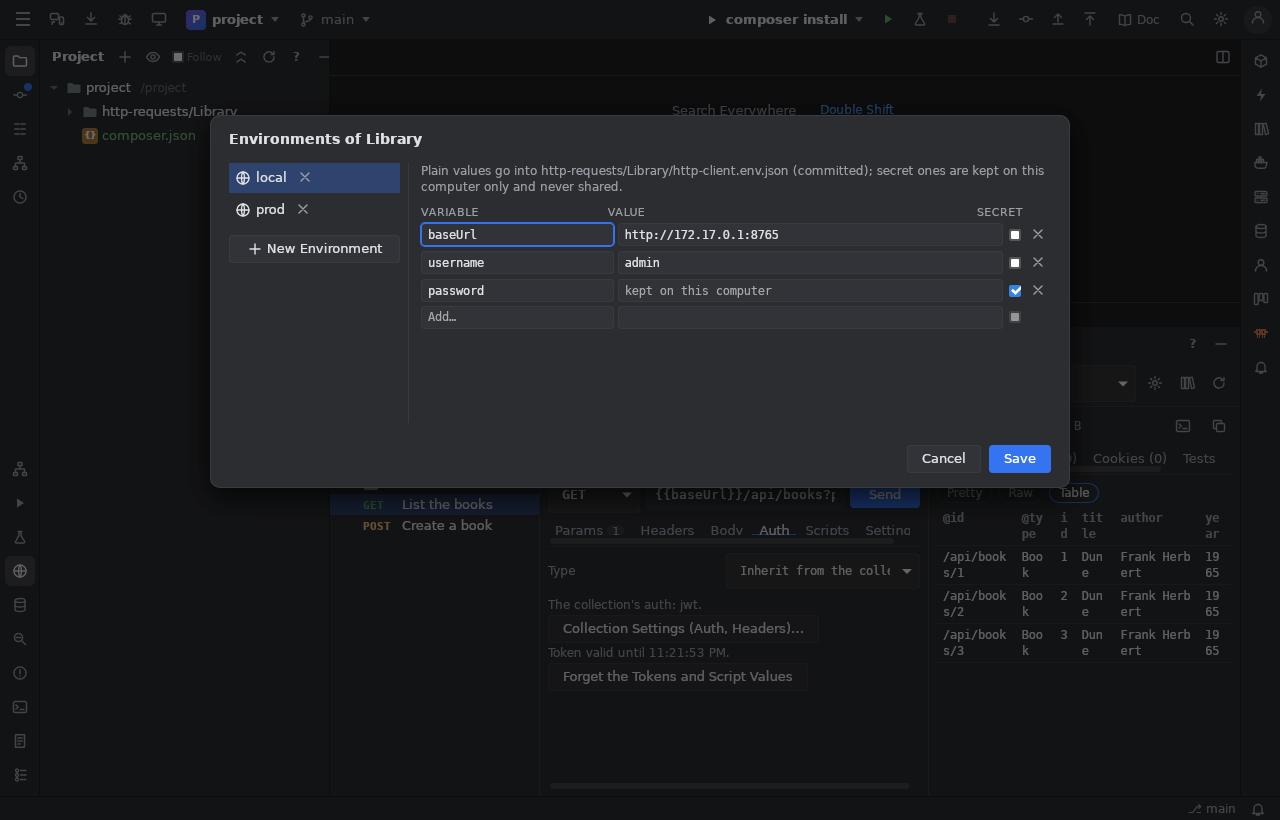
Environments… (the toolbar) edits the environments of a collection (local, prod…); the Library selector chooses the one in
use.
{{name}}is replaced by an environment variable, a value set by a script or a login, or a@name = valueline of the file.- Dynamic values:
{{$uuid}},{{$timestamp}},{{$isoTimestamp}},{{$randomInt}},{{$random.integer(1, 10)}},{{$random.alphanumeric(8)}},{{$random.email}}. - Secrets: tick Secret on a variable. Its value, the tokens and the values set by scripts are kept on this computer only
(
~/.jumphp/ide-http-secrets.json, readable by you alone): never in the project, never sent to jumphp.net, masked in the history.
Authentication
Set on the collection (Collection Settings…), inherited by its requests, or chosen per request in the Auth tab (# @auth):
- none, bearer, basic, API key (header or query);
- JWT: a login request of the collection is sent, the token is read from its answer with a JSONPath and kept in a variable
(
{{token}}). The login is sent when there is no token, when it expires in less than 30 seconds, or once more when the API answers 401; - OAuth2: client credentials or password grant, the token kept until
expires_in.
Forget the Tokens and Script Values in the Auth tab starts again from nothing.
Scripts and tests
Scripts run in a Web Worker without network access, and stop after 3 seconds. Available: client.global.set / get,
client.test(name, fn), client.assert(cond, message), request.variables.set, req.setHeader / setBody / setUrl (before the
request), response.status / body / headers / responseTime, expect(x).to.equal / eql / have.property / include / match / above / below / lengthOf, .not, jsonpath(data, path) and console.log. Bruno's bru, res, req and test() work too. Snippets
inserts common ones; the Tests tab of the answer lists the results (2/2 tests).
The answer
The IDE itself sends the request (HTTP/1.1, gzip, chunked, cookies kept per site until the IDE closes). It shows the status, the time
(connect / TLS / wait / download), the size, headers, cookies, the test results and the body: Pretty (JSON, XML, HTML), Raw, a
Table (a JSON array, an API Platform member), an HTML preview (sandboxed) or the picture. A JSONPath filter narrows the body,
Ctrl+F searches it, Copy as curl copies the command. The Timeline shows the chain of redirects. The only thing sent about
you is User-Agent: jumphp-ide, unless the request sets one.
Preview draws an HTML answer as the site would: the IDE fetches its stylesheets (and their @import, fonts and url() pictures),
<img> / srcset pictures, inline-style pictures and icons, relative to the response's address, with the request's own TLS
setting and cookies, and puts them inside the page. Only the page's own host (and its sibling subdomains, or localhost for a local
page) is ever contacted, at most 8 MB a resource; other hosts, private addresses and redirects out of the site are refused.
The note beside Reload resources lists what could not be loaded (hover it). The frame stays sandboxed; Scripts (off by
default) runs the page's own scripts.
Refresh from the API
The blue Refresh from the API (OpenAPI / API Platform) button of the toolbar pulls everything the project says about its API into
one organised collection, API: a folder per resource (API Platform's short name, or the OpenAPI tag), one request per
operation inside it, sorted (list, get, create, replace, update, delete, then the custom operations), the JWT login in auth/ when
lexik/jwt-authentication-bundle is installed (the collection's authentication), and an environment whose {{baseUrl}} is the
address of the local site (see OpenAPI below).
- With API Platform the requests are made from the code (the API Platform window's generator: example bodies from the writable
properties, the filters as query parameters). Otherwise they come from the OpenAPI description: the running site's, or the project
file (
var/openapi.jsonafter Regenerate the schema). - Running it again is safe: a request you edited is never overwritten (the new version is written beside it as
*.theirs.http), untouched requests follow the code, new operations are added, and untouched requests of operations that disappeared are deleted. A summary says how many were added, updated, kept, removed and unchanged. What the tool wrote is remembered by hash in.apiplatform.jsonof the collection.
OpenAPI
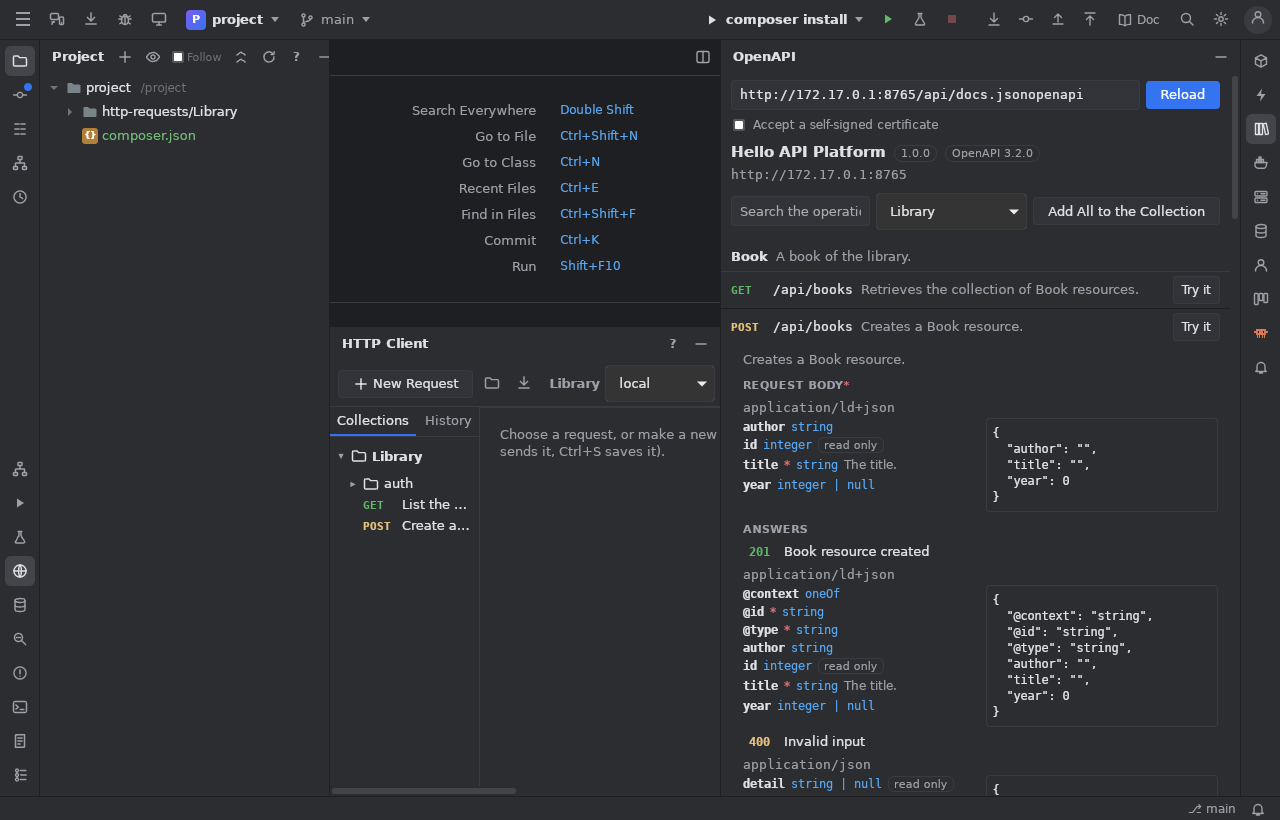
The description comes from a file of the project (openapi.yaml|json, swagger.*) or from an address: API Platform's
/api/docs.jsonopenapi, /api/docs.json, NelmioApiDocBundle's /api/doc.json, on the address of the project's local site: the
port of bin/jumphp web:serve (the "Serve the site" run configuration, also for symfony-docker), the published port of the PHP / web
service of your own compose file, else DEFAULT_URI / APP_URL of .env (a bare http://localhost is only Symfony's placeholder: it
comes last). The window asks each candidate address and keeps the one that answers. OpenAPI 3.x and Swagger 2.0, JSON or YAML; $ref are resolved, allOf merged,
and an example is made from each schema.
- The line under the address shows the local site (its address, running or not). When it is not running, Start the site runs the "Serve the site" run configuration, and the description is loaded by itself as soon as the site answers.
- Regenerate the schema (API Platform, NelmioApiDocBundle) runs the project's own console, through the Console window's runner
(Docker or the computer's PHP):
api:openapi:export --output=<file>ornelmio:apidoc:dump --format=json, writes the file (var/openapi.jsonby default, or the project file typed beside the button, remembered) and loads it: the schema is there even when the site is stopped. Reload asks the site again. - Search the operations filters the list; each shows its parameters, request body, answers and examples.
- Try it opens the operation in the HTTP Client, already filled: path parameters, required query parameters, Accept and Content-Type, an example body, and the authentication of its security scheme (the collection's, when it is bearer, JWT or OAuth2).
- Add All to the Collection writes a request file for each operation, one folder per tag.
- Accept a self-signed certificate is for a local site.
Import, export, sharing
- Import:
.httpfiles (several requests separated by###), Bruno.brufiles and folders (with their environments), or pasted text. Export a request, a folder or a collection as.httpor.bru. - Share with the Project's Members… then Sync Now: the files go to the jumphp.net project; members read them, the owner and
the members with write access change them. A change on one side goes to the other; a file changed on both sides keeps this
computer's version and writes the other one beside it as
<name>.theirs.http(never shared). Environments travel without their secret values.
Limits
- Scripts have no network and a 3-second limit.
- Requests are sent in HTTP/1.1.
- Cookies are kept until the IDE closes.
- Secrets stay on one computer: each teammate fills them in.