API Platform
The API Platform window (bottom tool bar; Search Everywhere: API Platform: …) appears in a project whose composer.json requires
api-platform/core (or another api-platform/* package). It reads the API from the sources, without running anything: the
#[ApiResource] attributes of the classes of the PSR-4 folders (entities and DTOs, promoted constructor properties too), their
operations, #[Groups], #[ApiProperty] and #[ApiFilter]. Five tabs; the window can take the whole screen (its ⤢ button, Escape gives
it back). In the Doctrine window, the entity editor and the diagram's menu have an API Platform… entry that opens a class here.
API Platform not installed yet? Ticking API Platform resource (#[ApiResource]) in the New entity dialog shows a notice
(API Platform is not installed in this project) with an Install API Platform button; so does New… > Install API Platform….
It shows the command (composer require api, the Symfony Flex pack, for Symfony 6.4+ with Flex; api-platform/symfony without Flex;
api-platform/core:^3.2 / ^2.7 for older Symfony, read from composer.lock), runs it through the Composer window's runner with its
output shown live, and the API Platform window appears without restarting the IDE. Declined: the attribute is still written, with a warning
that the class is undefined until the package is installed. Any other undefined class (Undefined class 'X\Y') has the quick fix
Install the missing package… (candidates: a built-in map of common namespaces, then Packagist).
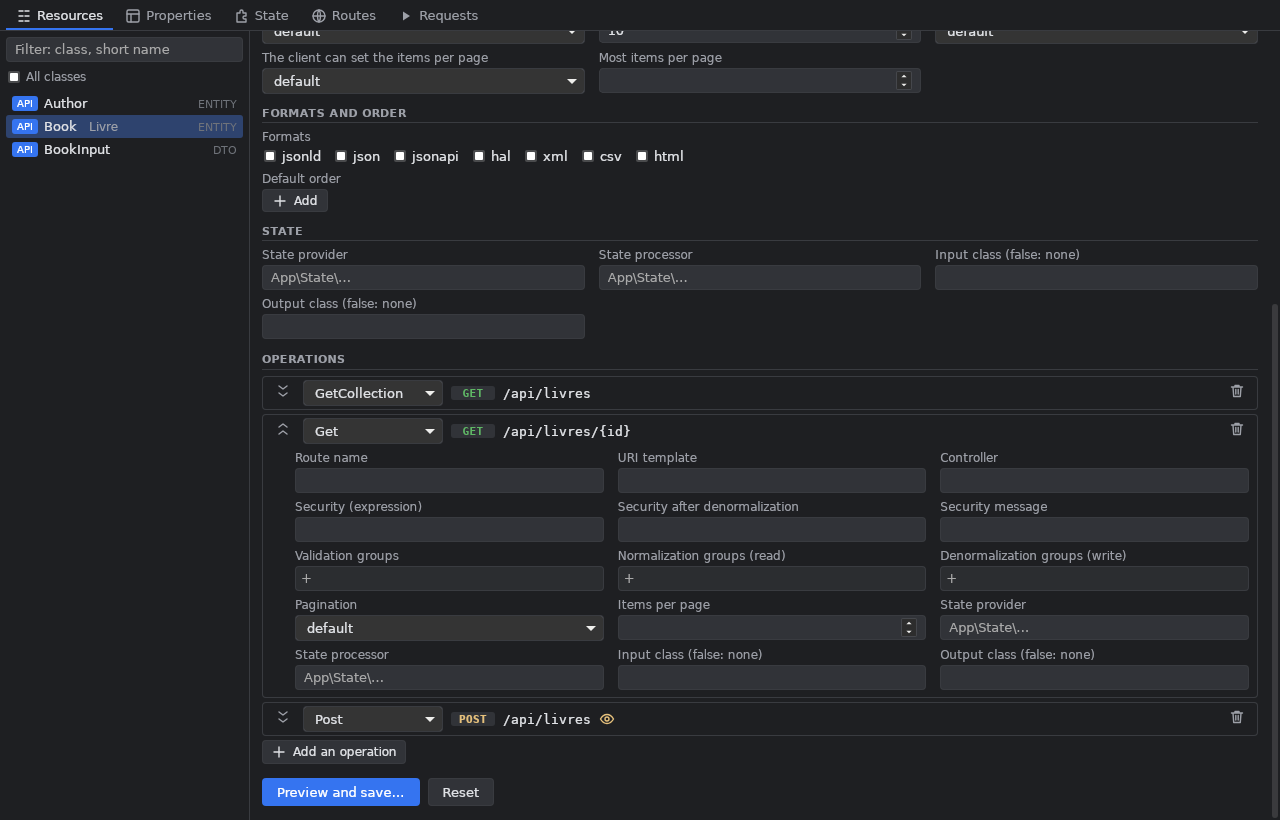
Every change is computed here and shown as a diff first; nothing is written before Apply. Only the touched arguments change: the
attribute is edited argument by argument (php-parser positions), everything else keeps its exact bytes, the style of the list (one line
or one argument per line) is followed, and the use lines are added. A value the code holds as an expression (security: self::RULE,
'groups' => [Book::READ]) is shown as such and never rewritten.
Resources
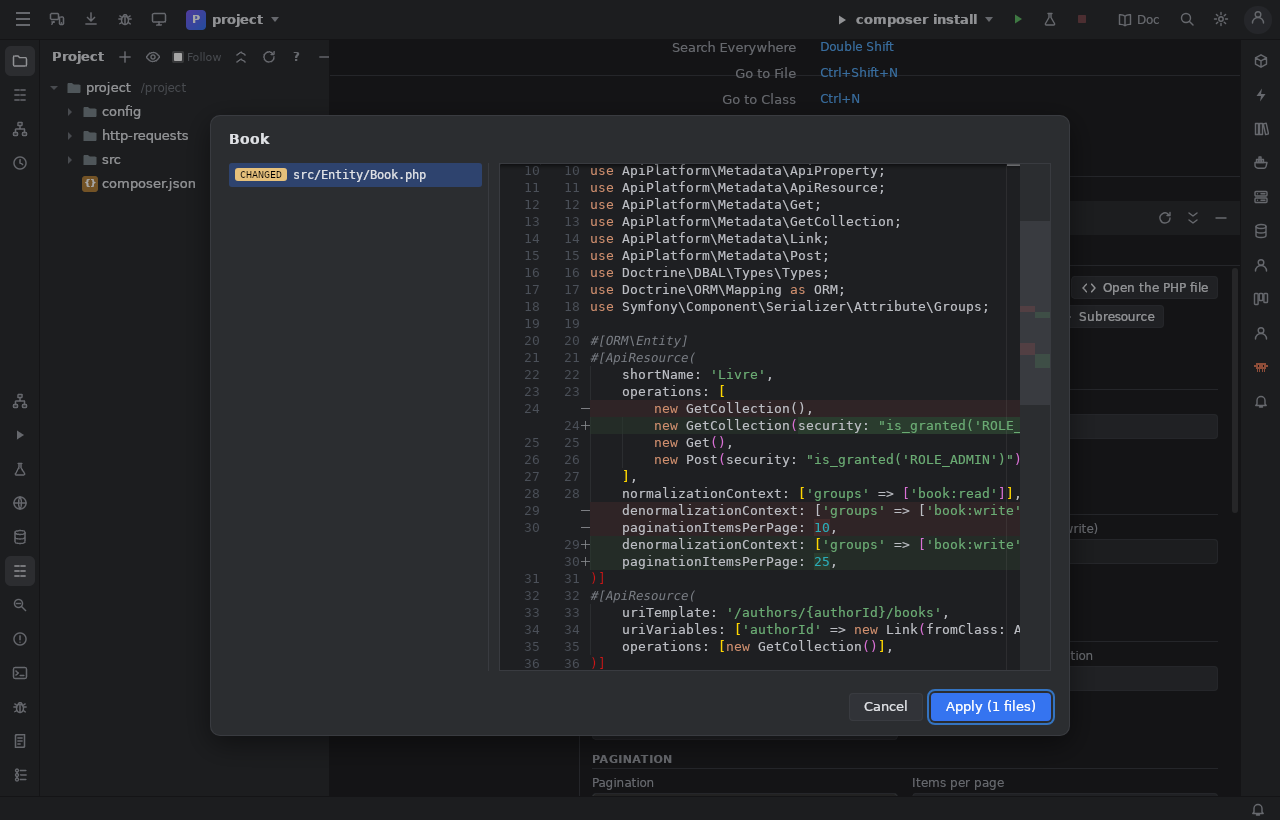
The list on the left holds the project's entities and DTOs (API badge when the class has #[ApiResource]; filter by class or short
name). For the chosen class:
- #[ApiResource] on / off: Expose it with #[ApiResource] adds the attribute (with its
use), Remove #[ApiResource] takes it away. A class with several#[ApiResource](a subresource has its ownuriTemplate+uriVariables) shows one chip per attribute; Subresource adds another one. - General: short name, URI template, URI variables (
new Link(fromClass:, fromProperty:, toProperty:)). - Serialization and validation: the normalization, denormalization and validation groups (chips; the other keys of the context,
enable_max_depth... stay). - Security:
security,securityPostDenormalize,securityMessage. - Pagination: enabled (default / yes / no), items per page, the client's control (on / off, items per page), the most items per page.
- Formats and order:
jsonld,json,jsonapi,hal,xml,csv,html; the default order (['title' => 'ASC']). - State:
provider,processor,input,output(a class, orfalse). - Operations:
Get,GetCollection,Post,Put,Patch,Delete, each with its route (method and path) and its own options (name,uriTemplate,controller, security, groups, pagination, provider / processor / input / output): add, remove, change the type, fold / unfold. When the code lists none, API Platform's defaults are shown (Get, GetCollection, Post, Patch, Delete; Put too before API Platform 4); Make them explicit to edit them writes the list.
Properties
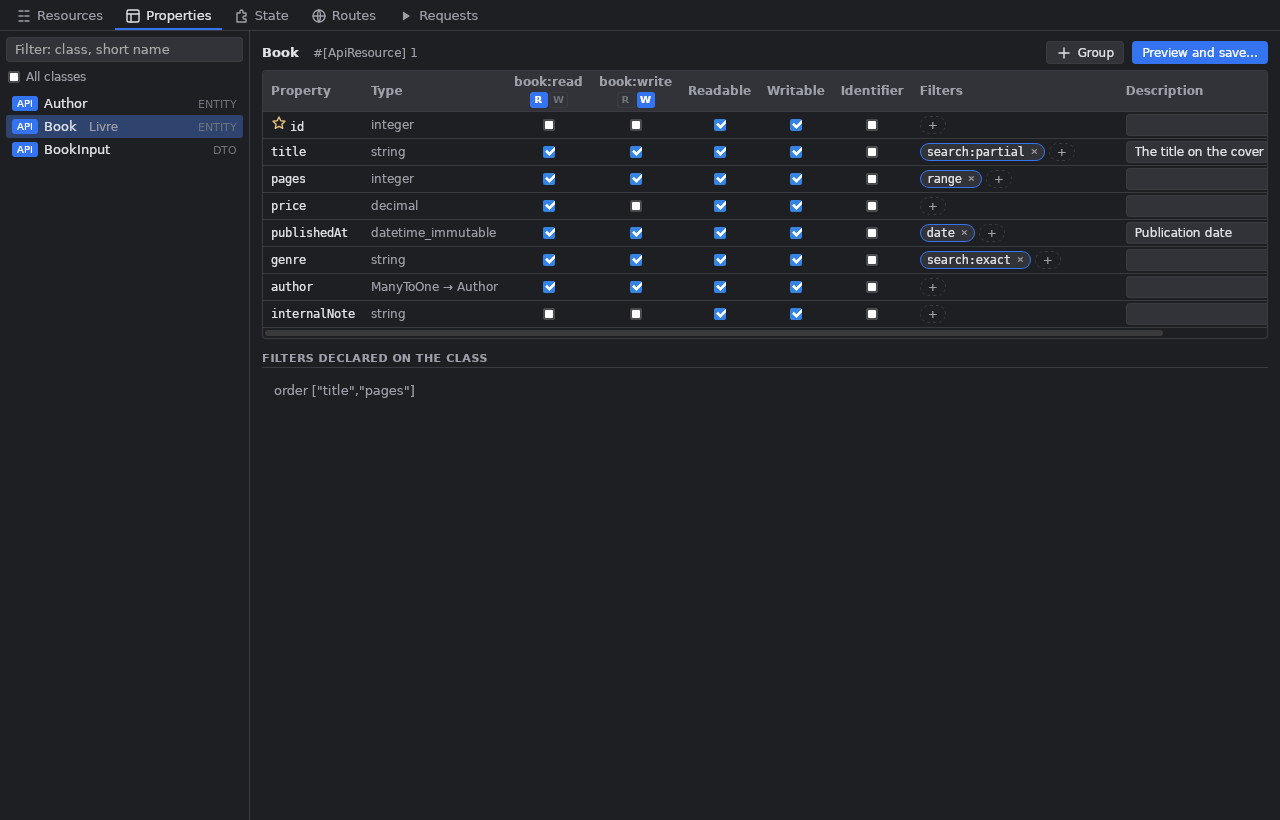
A grid, one row per property (a key marks the identifier; the Doctrine type or relation is shown). Group columns: the serialization
groups of the resource's contexts and of the properties; each cell is the #[Groups([...])] attribute (created, changed or removed). In
the header, R and W tell whether the group is a read group (the resource's normalizationContext) and / or a write group
(denormalizationContext); toggling them edits the resource in the same diff, and + Group adds a column. Then: Readable,
Writable, Identifier, Description, Example (#[ApiProperty], removed when it has no argument left) and Filters:
SearchFilter (strategy exact, partial, start, end, word_start), OrderFilter, RangeFilter, DateFilter, BooleanFilter,
ExistsFilter, NumericFilter as #[ApiFilter(...)] attributes (a filter already there keeps its other arguments). Filters declared on
the class are listed below the grid.
State
The classes implementing ProviderInterface / ProcessorInterface, with where they are used. New provider… / New processor…
write a class from a template (src/State/), optionally decorating Doctrine's own (the collection / item providers, the persist
processor, injected with #[Autowire]), and wire it to the resource in the same diff (processor: BookProcessor::class). Wire…
connects an existing one.
Routes
Every route, worked out from the code (method, path with the prefix of config/routes/api_platform.yaml, resource, operation, security,
name); a click opens the resource. Compare with debug:router runs debug:router through the Console window's runner and marks each
route ✓ / ✗, and lists the API routes the console has that the code does not explain. OpenAPI export shows api:openapi:export.
Requests
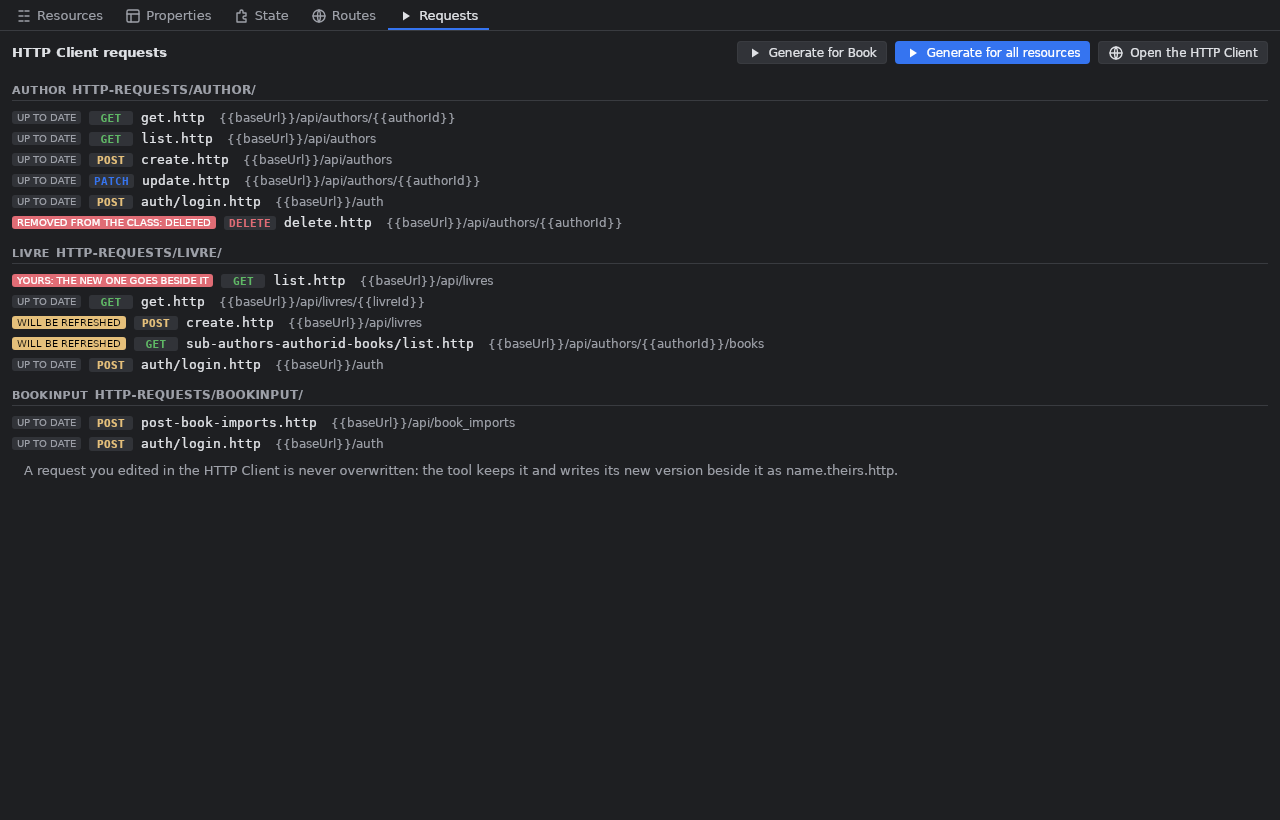
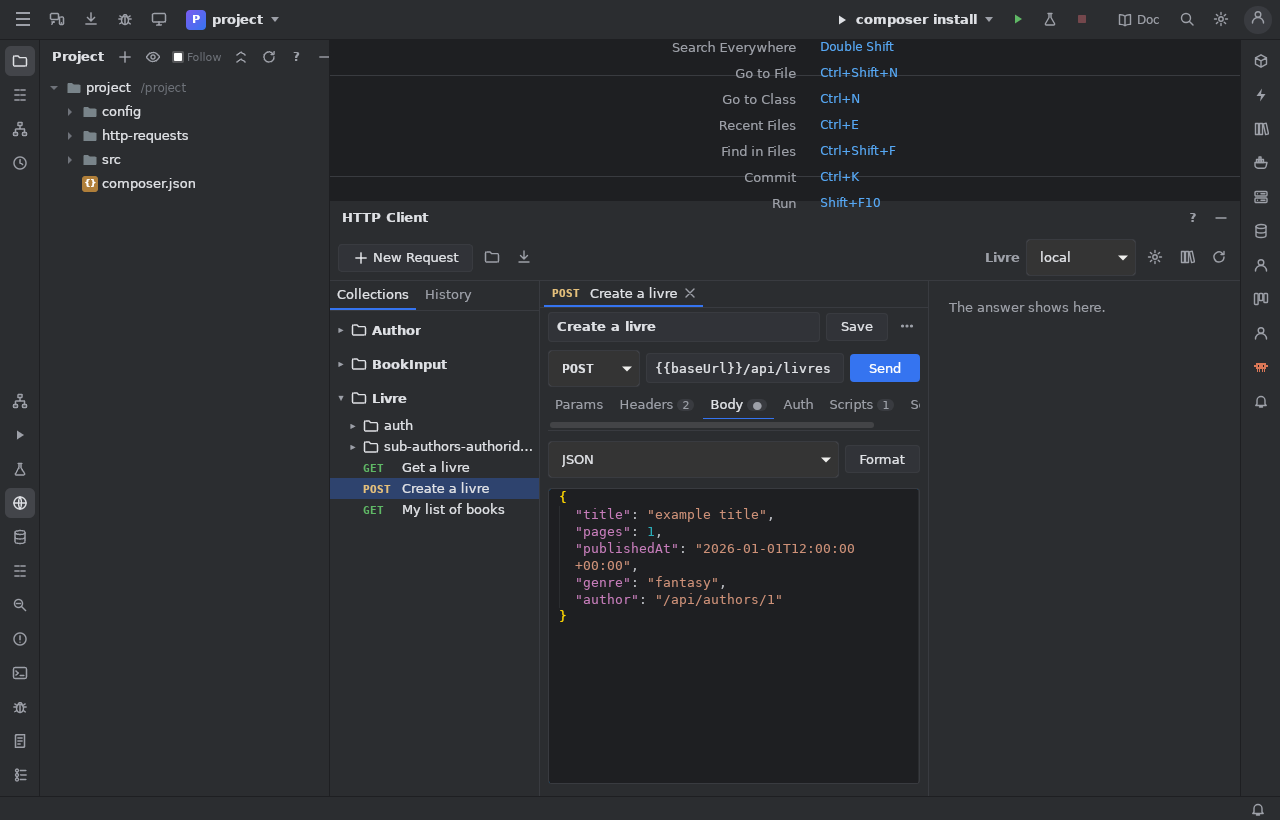
Generate for all resources (or for one) makes, for each resource, an HTTP Client collection http-requests/<Resource>/:
- one
.httpfile per operation (list,get,create,replace,update,delete,<custom>; subresources in asub-…folder): URL under{{baseUrl}}, the method,AcceptandContent-Type(application/ld+json, or the first offormats;application/merge-patch+jsonforPATCH), an example body built from the properties the operation writes (the denormalization groups,#[ApiProperty(writable: false)]out, theinputclass when there is one) with example values by type (#[ApiProperty(example:)], the first case of an enum, an IRI for a relation), the filters as commented query parameters (# ?title=…,# ?order[title]=asc,# ?pages[gte]=1,# ?page=2), a status test, and a script saving the new id ({{bookId}}used by the other requests); - a new collection gets the environment (
baseUrl, the ids, the login) and, withlexik/jwt-authentication-bundle, a JWT login request (read fromsecurity.yaml) the collection's auth uses.
Regeneration follows the class, with one rule: a request someone edited is never overwritten. The collection's .apiplatform.json
keeps the hash of what the tool wrote. A file still equal to it is rewritten (or deleted when the operation is gone); a file that differs,
or that the tool never wrote, stays as it is and the new version goes beside it as name.theirs.http (only when there is something new
to say). The window shows the state of every file (new, will be refreshed, up to date, yours kept, deleted) and the diff before writing.
Tests
ide/tests/ApiPlatformTest.php: the attributes read from several shapes, the exact text of every change (tests/fixtures/api-platform-expected/),
the property grid, State classes, the requests and the regeneration rules. games/ide/tools/api-platform-check.sh <a copy of a Symfony project with api-platform/core> is the real check: an entity made through the Doctrine window's backend, #[ApiResource] edited, debug:router, and the
generated requests run by the HTTP Client against php -S. games/ide/tools/ui-api-platform-check.sh takes the screenshots of this page.